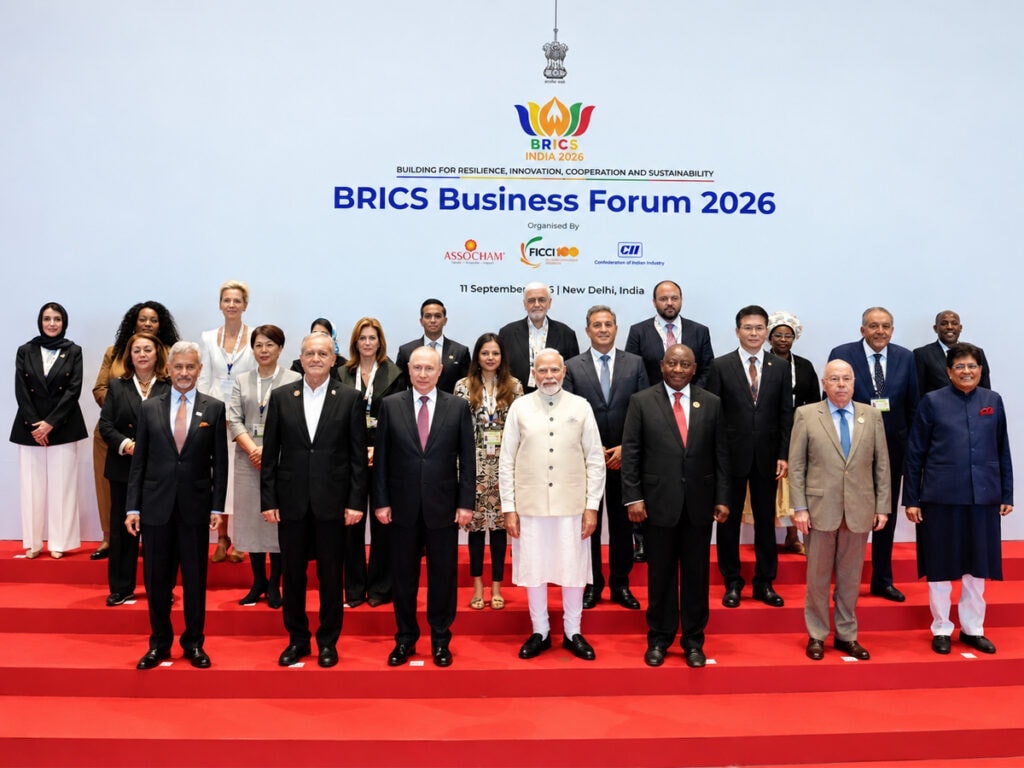
The 2026 BRICS Summit concluded in New Delhi with a 140-point declaration spanning global governance, trade, AI, finance, sustainability and development, as an expanded group of emerging economies sought to turn its growing global weight into practical cooperation.
What happens when a group representing some of the world’s largest emerging economies tries to find common ground at a time of geopolitical uncertainty, shifting trade relationships and rapid technological change?
The 18th BRICS Summit, held in New Delhi on September 12th-13th 2026, offered one answer: keep the table broad, focus on areas where cooperation is possible and give emerging economies a larger role in shaping the systems that govern the global economy.
Hosted under India’s 2026 chairship and the theme “Building for Resilience, Innovation, Cooperation and Sustainability,” the summit brought together leaders from an expanded BRICS at a particularly consequential moment for international cooperation.
Its central outcome was the New Delhi Declaration, a 140-point consensus document covering global governance reform, economic cooperation, cross-border payments, artificial intelligence, science and technology, sustainability, health, food and energy security, entrepreneurship and people-to-people engagement.
But the significance of New Delhi went beyond the number of commitments on paper.
For BRICS, now entering its third decade, the bigger question is whether a grouping built around economies with very different political systems, strategic priorities and development paths can translate its expanding influence into practical leadership.
From a Smaller Group to a Broader Global Platform
BRICS began with Brazil, Russia, India, China and South Africa. Its expansion has brought Egypt, Ethiopia, Indonesia, Iran and the UAE into the grouping, alongside a wider network of partner countries.
That diversity makes consensus more complicated, but also gives agreement greater weight when it is achieved.
The New Delhi Declaration reaffirmed the group’s commitment to cooperation across three broad pillars: political and security cooperation, economic and financial cooperation, and cultural and people-to-people engagement. It also called for a more representative international system in which emerging markets and developing countries have a greater voice in global decision-making.
India’s Ministry of External Affairs said more than 50 practical outcomes emerged during its chairship, following over 400 meetings and engagements held across 30 Indian cities.
For leaders, that offers an important distinction. BRICS is increasingly attempting to move from being primarily a forum for dialogue towards building mechanisms that can continue operating between annual summits.
What New Delhi Put on the Table
| Priority | What BRICS Advanced in New Delhi |
|---|---|
| Global Governance | Greater representation for emerging and developing economies and continued calls for reform of international institutions |
| Trade & Investment | Deeper economic cooperation and work towards the BRICS Economic Partnership Strategy 2030 |
| Cross-Border Payments | Continued exploration of more efficient payment mechanisms and greater use of local currencies in trade and investment |
| AI & Innovation | Expanded cooperation in science, technology, emerging technologies and knowledge-sharing |
| Financial Cooperation | Further technical work on a New Investment Platform and India’s proposed BRICS Risk Lab |
| Women in Leadership | Greater emphasis on women’s entrepreneurship, access to finance, markets, skills and digital opportunities |
| Sustainability & Resilience | Cooperation around development, climate resilience, food, energy and stronger supply chains |
These areas illustrate a noticeable evolution in the BRICS agenda. Economic cooperation remains fundamental, but technology, resilience and human development are becoming increasingly central to the conversation.
The Global South as a “Rule-Shaper”
Perhaps the clearest leadership message from New Delhi concerned representation.
Indian Prime Minister Narendra Modi framed India’s BRICS presidency around a people-centric approach and argued for global institutions that better reflect contemporary economic realities. The wider declaration similarly called for greater and more meaningful participation by emerging markets, developing countries and least-developed countries in international decision-making.
That idea sits at the heart of BRICS’ growing relevance.
The group’s ambition is not simply to increase trade between its members. It is also seeking greater influence over how international institutions respond to economic development, finance, technology and global challenges.
The declaration backed reforms to global governance institutions and reiterated the need for emerging and developing economies to gain greater representation, including within international financial institutions.
For business leaders, this matters because changes in global governance eventually reach companies through investment flows, trade rules, payment infrastructure, technology standards and access to capital.
Technology Moves Closer to the Centre
Another striking feature of the summit was the prominence given to technology and innovation.
BRICS leaders identified science, technology and innovation as important drivers of sustainable economic and social development. The declaration welcomed work towards a BRICS Science and Research Repository, while cooperation is also developing in emerging fields including quantum technologies.
The shift reflects a broader reality: leadership among emerging economies is increasingly being defined not simply by economic scale, but by their ability to build technological capabilities.
That creates room for BRICS cooperation to move into areas that will shape the next decade — AI, digital infrastructure, research, skills and innovation ecosystems.
A Pragmatic Approach to Financial Cooperation
One of the most closely watched areas was finance.
Rather than announcing a single new BRICS currency, the declaration focused on more practical steps, including work by the BRICS Payment Task Force on cross-border payment interoperability and discussions around using members’ local currencies for trade settlements and investment.
Members also expressed interest in further discussions around India’s proposal for a BRICS Risk Lab at GIFT City, while technical dialogue is continuing around a potential New Investment Platform.
That incremental approach may prove important. Instead of attempting to redesign financial architecture overnight, BRICS is exploring mechanisms that could gradually make transactions between member economies more efficient.
Consensus Becomes a Leadership Outcome
The summit unfolded against a complex international backdrop, including heightened tensions in the Middle East and continuing debates around tariffs, sanctions and global trade.
Yet members still adopted a common declaration.
The document emphasised dialogue and diplomacy in resolving international disputes and called for restraint amid escalating tensions. Reuters reported that reaching consensus was particularly significant given the different strategic relationships represented within the expanded grouping.
For BRICS, consensus itself therefore became part of the story.
The grouping does not require its members to approach every global issue from the same perspective. Its challenge is whether countries with different interests can identify enough common ground to cooperate where their priorities overlap.
New Delhi demonstrated that, at least on a broad development and governance agenda, they can.
What Comes After New Delhi?
The final measure of the 2026 summit will not be the declaration itself, but what happens after leaders leave the room.
Work will continue on payment systems, investment frameworks, innovation, institutional development and economic cooperation. India has now handed the BRICS chairship to China for 2027, when the 19th BRICS Summit will be held.
That handover makes continuity important.
BRICS has expanded its membership and broadened its agenda. Its next phase will depend on whether it can convert that scale into sustained outcomes without losing the flexibility that allowed such a diverse group to grow in the first place.
For leaders watching from outside the summit, New Delhi offered a wider lesson.
Influence in today’s world is increasingly built not only through economic strength, but through the ability to convene different perspectives, create common ground and turn dialogue into institutions that endure.
The 2026 BRICS Summit did not attempt to resolve every difference among its members. Instead, it showed something potentially more useful: that countries do not have to agree on everything before they can begin building together.
Sources: BRICS New Delhi Declaration 2026; Prime Minister’s Office of India; Ministry of External Affairs, Government of India; Reuters; Associated Press.