



Thought Leadership

The House of Change
Written by Contributing Writer, Paul Seabridge
Change is emotional, even when it’s for the better, and we all deal with it in different ways. In business, the most successful and profitable businesses must constantly change. If you want a different result – increased profits, a better experience for customers, more staff engagement – you need to do things differently, so if you want to increase your profits, you’ll have to make changes.
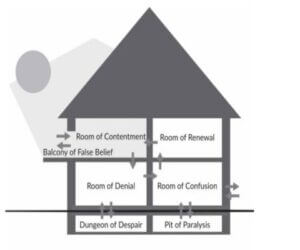
‘The House of Change’ is a great exercise to run with a team to kick-start a change management process. I have developed a theory that I call the Four Rooms of Change. In the process of change, we go through different phases. I liken these to four rooms – the Contentment Room, the Denial Room, the Confusion Room and the Renewal Room. People can reach these rooms at different times, and we all move through at our own pace. There are a few doors off those rooms that we can also slip into if we encounter challenges.
Let’s take an example, where you work in banking. Google, Apple and Amazon have all entered the banking business. Their previous huge success means they have acquired a big cash position and they have begun to offer financial services including credit cards and commercial loans.
When we’re in the Contentment Room of the House of Change, we don’t see a need to change. Our current situation is satisfying and we have no desire for anything to be different. In this case, we’ve been banking a certain way for years and it pays off. Why change? People can get stuck here for a long time.
Then Google makes their big move and we are caught off guard. We are triggered into the next phase and we enter the Denial Room. Yet we still don’t see the threat. Why would we change?
Google doesn’t have our banking experience and our customers are familiar with our bank and our ways. People can get stuck in this phase and fall into the Dungeon of Denial.
But once the need for change is accepted, you enter the Confusion Room. Here, fear, anger and (internal) conflict take over. We don’t know how to react because the situation is new to us. ‘How can we compete with Google? Are they also entering the mortgage market?
What are other banks doing? I should have seen this coming… they have such a big cash position.’ It takes dedication and commitment to get to the next phase.
The big risks in this phase are over-analysing the current situation and possible outcomes and getting stuck in the Paralysis Pit, or just plain giving up via the Wrong Direction Door.
When it all falls together, we enter the Renewal Room. We have made up our minds, worked out a new approach and are ready to take up the challenge.
We know how to deal with the new threat, we have trained our clerks to respond to customer questions about Google. But the journey doesn’t end here; we should prepare ourselves for another ride through the house – we don’t know what’s up next.
Share the theory with your team and use an example applicable for your situation. Other examples include:
- Print media vs the internet
- Book press industry vs the Amazon Kindle
- ICQ and MSN Messenger vs Facebook chat
- Telecoms industry vs Skype
- Nokia vs the smartphone with touch interface
- Classic mortgage loans vs public loans
- Fund investments vs direct investments by
Individuals
People in denial (of change) are often hard to deal with because they’ll also deny that they’re in denial. Deal with this by emphasizing the need for change.
Provide facts. Repeat the ‘why’ of the change at every opportunity (at the coffee machine, in a meeting, with a presentation). Acknowledge, don’t ignore, their feelings. Listen to what employees have to say. Talk to them, put everything on the table.
Involve people who resist. They may still use their energy to complain and push their feedback but try to use this energy to your advantage. Those who react apathetically or have given up will be more difficult to get on side than those who care.
A one-page strategy
All changes should be strategic, should move you closer to realizing your vision for the company. Sharing this strategy can hugely help with getting team members on board with change. I mentioned earlier that a good leader is someone who can define a strategy and vision and get the team to buy into it.
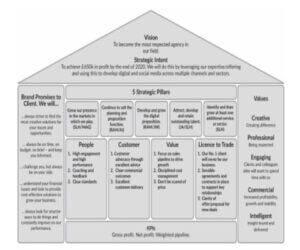
Here is an example of a strategy on one page devised by the executive team of a business I was involved in. You can see it gives a basic outline of the company’s strategy: the who, the what, the how, the measures.
It’s essential to have measures so you can determine if and when the strategy has been delivered and you know what success looks like. It is all on one page so it is easy to refer to.
About the author:
Paul Seabridge is a global entrepreneur, published author, private investor and corporate advisor. He has been an active investor in SMEs for almost two decades and is CEO and Founder of Mergers, Acquisitions, Private Equity firm Opulentia Capital. Opulentia Capital helps companies achieve scale by taking them public, and the team has completed over $1/4bn worth of deals, across 90+ transactions, 9 countries and 26 industries.
Paul’s new book Buy, Build, Sell, shares his expertise in buying or starting a business and developing it to its full potential, covering topics such as recruitment, sales, business finance and accounting and then how to sell on a business through an IPO, merger, acquisition or similar.

Written by contributing writers, Anne Mieke Eggenkamp and Fennemiek Gommer, co-founders, Caracta Business Innovation Innovation requires looking at the world from different perspectives and...


Written by Contributing Writer, Rachel Turner Stress, overwhelm, and exhaustion is ubiquitous among founders. It’s no surprise, then, that recent research identifies founder burnout as one of the...

New Survey Finds 51% Of Organisations Have Never Completed An Equal Pay Audit A new pulse survey by reward consultancy 3R Strategy, which investigates pay budgets, pay transparency, and equal pay...

Written by Contributing Writer Surendra Challapalli, Vice President – Business System Analysis Sr Manager, Citi In today’s fast-paced digital landscape, organizations are increasingly...

Written by Contributing Writer, Allison Jones Thankfully, the conversations we’re having around inclusion and diversity have changed over recent years. Most leaders now understand that having a diverse...

A survey into leadership competency has revealed that only 14% of leaders are influential, despite over 85% being ranked as competent leaders. Created by Judith Germain, the survey data was collected from...

Meeting is a word that tends to be most unwelcome in business. Do you ever feel that all you do all day is attend meetings? Meetings about sales, finances, what type of fridge would suit the team, and my...

Often in organizations, the focus is on looking after the mental health of the employees; however, it is just as important to ensure leaders take care of their own mental well-being. How can a leader...

Written by contributor writer, Dominic Monkhouse, Founder & CEO of Monkhouse and Company Every great or aspiring-to-be-great business needs an amazing hiring and onboarding process. But for a company...