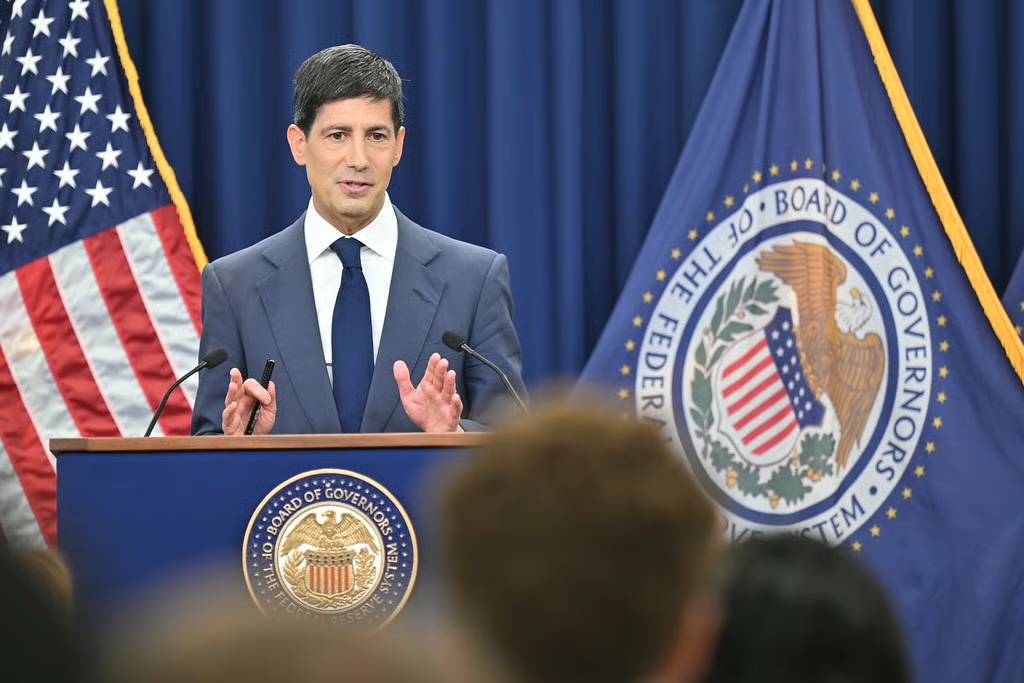
Federal Reserve Chair Kevin Warsh faced one of the most closely watched US monetary-policy meetings of the year as officials voted to keep interest rates unchanged despite persistent inflation concerns.
The Federal Open Market Committee voted 9–3 to maintain the federal funds rate within its existing 3.50% to 3.75% range. Cleveland Fed President Beth Hammack, Minneapolis Fed President Neel Kashkari and Dallas Fed President Lorie Logan dissented, favouring a quarter-percentage-point increase.
The decision revealed a significant division within the central bank over whether policymakers should act immediately against inflation or wait for further economic data.
Addressing reporters after the meeting, Warsh acknowledged the intensity of the internal debate.
“I asked for a good family fight, and I got one,” he said, describing the disagreement as a deliberate part of the policymaking process rather than a sign of dysfunction. He added that the discussion had been active and robust, with broad agreement on the Fed’s responsibility to restore price stability.
Markets React to Lack of Clarity
Although investors initially welcomed the decision not to raise rates, sentiment reversed during Warsh’s press conference as he provided limited guidance on the central bank’s next move.
The Dow Jones Industrial Average closed 1,153 points lower, declining approximately 2.2% in its worst session of the year. The S&P 500 lost 1.5%, while the Nasdaq Composite fell 1.7%.
Pressure was particularly visible in the bond market. The yield on the 30-year US Treasury moved above 5.2%, reaching its highest level since 2007 as investors demanded greater compensation for the risk that inflation could remain elevated for longer.
The market reaction suggested that investors were not only responding to the decision itself, but also to uncertainty surrounding Warsh’s policy framework.
He has sought to reduce the Fed’s reliance on detailed forward guidance, arguing that markets should interpret economic conditions more independently. However, critics say the approach may create greater volatility when investors cannot clearly determine how the central bank will respond to inflation, employment or economic growth.
A Difficult Inflation Debate
Warsh maintained that the Fed remained committed to its price-stability mandate, but declined to indicate whether officials were preparing to raise rates at their next meeting.
He said policymakers would continue examining broader economic trends rather than relying on any single inflation report. The next rate decision is scheduled for September, giving the central bank several weeks to assess employment, consumer spending, energy prices and inflation data.
The three dissenting officials argued that waiting too long could allow inflation to become more deeply embedded in the economy. Their opposition is particularly notable because all three supported tightening policy in the same direction, strengthening pressure on Warsh to explain why holding rates steady remains appropriate.
Meanwhile, the Fed must balance inflation risks against the possibility that higher borrowing costs could further weaken housing, consumer credit and other interest-rate-sensitive areas of the economy.
An Early Leadership Test
The meeting has emerged as a defining early test of Warsh’s leadership at the Federal Reserve.
His willingness to encourage disagreement may allow policymakers to examine economic risks more openly. Yet the sharp response from stocks and bonds also demonstrates the importance of clear communication from the world’s most influential central bank.
Warsh now faces pressure from dissenting colleagues seeking tighter policy, markets demanding greater clarity and political leaders who have previously advocated lower borrowing costs.
The September meeting could therefore prove even more consequential. Unless inflation eases meaningfully, Warsh may need to choose between maintaining his patient approach and supporting the rate increase already being demanded by a growing group within the Fed.
Sources: Federal Reserve, Reuters